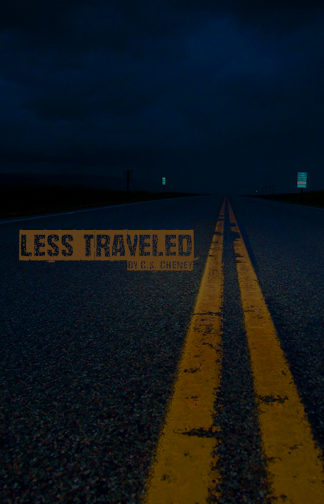
Calvin, in a downpour, in the dark, outdrove his headlights. If an animal wandered into the road, he would have zero seconds to avoid splattering it across the pavement. The wipers provided a slideshow, and his eyes strained, tracing the broken line of yellow rectangles.
He’d forgone passing a semi so he could watch its taillights and know when the turns on the narrow road were coming. He made himself blink and rolled his shoulders.
He looked out the side window. Past the tops of whatever dead and dried crop populated the fields, right at the edge of the light, the dark was absolute. It made him uneasy.
“That’s the kind of blackness that made us afraid of the dark,” he said.
“Hmm,” she said, not looking up from her phone.
“Look.”
“What?”
“Look how dark it is.”
The rain lessened as they talked. She lowered the phone. “Are we lost?”
To his ears, it sounded a bit accusatory. “I’m just going where the nice lady on the phone tells me.”
The truck lights, further away than the last time he’d looked, vanished around a turn.
“Jesus. You can’t see anything at all,” she said.
“You can sorta see water in the ditches.”
“Those aren’t ditches. That’s a swamp. Where are we again?”
“Mississippi?”
“See. Swamps.” She said it like Bubba said “Shrimps” in Forrest Gump.
They lapsed into silence, and he, squinting into the dark and light and rain, accelerated trying to catch the truck. The needle crept toward 70.
She screamed. He tensed, the wheel jerked, and the SUV swerved on the slick road.
“Em, what the …”
“That was a goddamn clown!”
He nodded, because he’d seen something out of the corner of his eye, white-and-red headed with blues below. More a blur than anything. “Probably a scarecrow, don’t you think?”
“Yeah, maybe,” she said. Then, “No.”
“No?”
“Its head turned.”
“You’re imagining things.”
“I saw it move. I saw it.” Her voice had a bit of hysteria, high and wavering, so he clamped down on what he’d been about to say, waited a breath.
“I mean, no way. Even as a sick joke, that’s extreme. There’s nothing out here,” he said, gesturing to the dark. “We haven’t passed a house or farm or anything in half an hour. Who would do that?”
The next clown materialized in the middle of the road as though by magic. Calvin had time to think, there’s an actual clown in the road as his reflexes cranked the wheel left and mashed the brakes. At 70, and never a nimble beast, the Xterra shot off the road, motor screaming from lack of resistance, flew over the ditch and into the swampy crops. It bounced once, then the front end caught, standing the SUV up on its nose. Airbags punched them in the face. Then it pirouetted and slammed to the ground, headlights streaming back in the direction they’d come.
He tried not to hyperventilate. His face hurt. The sharp bite of gas and oil tweaked his nose. And expanding ring filled his ears. He looked toward Emma. “You okay?”
He pushed the airbag away, unbuckled his seatbelt, and leaned toward her. “Em?” He heard her then, her breaths short, more in than out. Her nose bled onto her lip, blood black in the dim light, but her eyes stared back at the road. He ran his hand across the side of her cheek, tucked a strand of brown hair behind her ear.
“You saw it that time, right?”
He nodded.
“Where did it go?”
He looked back toward the road. No clown. Back to her. “You okay?”
She blinked, slow, then moved her limbs, one after the other, systems check. She touched her face, hissed.
“No, but yeah.” Her gaze went back to the road. “Are we stuck? We need to get out of here.”
He looked back at the road, then down at the dash. He started to turn the key … “Wait. If the engine’s in the water and I start it …” He opened the door and peered down, black water undulating below the bottom of the car.
“What did you say?”
He realized he’d been mumbling. “We’re stuck. We need to get out.”
“Fuck that.”
“We can’t sit here.”
“Call 911.”
“I don’t even know … ” He stopped. Right. Map app. He fished his phone out of his pocket, unlocked it with this thumb. The light made him squint. He expected no service, but it showed a bar and a half. The network wasn’t AT&T, but MTBC, which was weird. The app, still in navigation mode, showed a blue dot indicating their location.
He made a note of it, dialed 911. It rang more too many times before the dispatcher answered.
“What is your emergency?”
“We’ve been in a car accident.”
“What is your name?”
He told her, then gave her his phone number. No, no one appeared to be seriously injured. No, no other cars were involved. She asked for their location.
“Somewhere off Highway 12 between Hollandale and Belzoni, I think. The dot on my map keeps moving.”
“I see.”
And then the dispatcher said nothing, which he thought was odd.
“Hello?” He waited.
Emma said, “What are they doing?”
He shrugged.
She crawled between the seats, bumping his shoulder with her hip.
“What are you doing?”
“Getting a bottle of water.”
The phone squelched in his ear.
“Sir?”
“Yeah. We’re still here.”
“Are your lights off?”
“What?”
“Your headlights. Are they off?”
“No.”
“Turn them off now, please.”
The hell? He turned off the headlights.
“What was the cause of your accident? Did you fall asleep at the wheel? Did someone run you off the road? Did you hydroplane?”
“Someone was standing in the road.”
“Did you collide with this person?”
“No, ma’am.”
“Are you certain?”
“Pretty sure.”
“Was it a clown?”
A wave of sensation cascaded from the top of his head, along his spine and arms, and into his bladder. “Yes.”
“Do you have any weapons?”
“Uh, a pocket knife?”
More silence.
Emma stopped moving in the back seat. He flicked his eyes to the rearview mirror, met hers. “She asked if it was a clown and whether we had any weapons.”
“The fuck?” She looked out the front window. “It is so dark out there, I can’t even see the road.” She glanced at him. “What the hell are they doing,” pointing toward the phone with her chin.
He shrugged again.
“I’m not sitting in this box in the dark and waiting for some psycho in a clown costume to find me.” She turned and leaned over the back seats. He checked her backside out in the mirror.
“Sir?”
“Yes.”
“We need you to stay put. We have officers en route. Would you like to stay on the line until they arrive?”
“No, that’s okay. Do we need to be worried?”
“Can you see the clown now?”
“No.”
“Good. That’s good.”
“Good?”
“If the officers haven’t arrived in 20 minutes, get back to the road and continue in the direction you were previously heading.”
“On foot? This thing isn’t getting out of here without a wrecker. And didn’t you just tell me to stay in the vehicle?”
“Would you like to stay on the line until the officers arrive?”
“Sure?”
He thumbed the phone to speaker, then pressed mute and set it on the dash. Emma climbed into the front, pulling her black backpack. She settled in the seat, clutched the bag to her chest, and resumed staring out the window.
“We’re holding on the line until the officers arrive. The dispatcher seemed to know about the clown.”
“Clowns,” she said, drawing out the S at the end.
“What?”
“There’s no way the second clown was the same as the first. Not unless it’s a magic teleporting clown. Two clowns.” She held up two fingers.
“Jesus.”
“Yeah.”
They stared out into the night. After a bit, she said, “How long has it been?”
He woke up the phone. “We’ve been on the phone for 18 minutes.” He tapped the volume rocker several times, cranking up the sound. They could hear keyboard clicks and squawks from radios in the background.
“Sir, are you still there?”
He unmuted, said, “Yes, we’re still here.”
“Have you seen a patrol car?”
“No, ma’am.”
“Are you sure you’re on Highway 12?”
He switched apps. “That’s what the app says.”
“We have had four officers searching Highway 12 between Hollandale and Belzoni. They have not found you.”
“You had us turn the lights off.”
“And that’s for your protection. You have not seen any traffic on the road? No patrol cars?”
“Nothing.”
“We need to get you moving. Do you have a flashlight?”
He nodded in the dark.
“Sir?”
“Oh, yeah. Sorry. We have a flashlight.”
“What about water? Food?”
“Yes.”
“If you have a tire tool in the back of your vehicle, I would take it. I wish you had a firearm.”
Emma looked at him, eyes wide. He waited.
“You need to get back up on the road and start walking East. If you can get to Belzoni, you’ll be safe.”
“What the hell kind of advice is that?” Emma said. “You’re supposed to be coming to help us.”
“We’re doing everything we can, ma’am. Get walking. Good luck, and God willing, we’ll see you in Belzoni.”
The dispatcher disconnected.
“What the fuck.”
He nodded.
“Get your backpack,” she said.
He nodded again, climbed through the seats and gathered his gear. He wished he had a gun. His brother always traveled with a gun in the car. A Glock of some kind. Kept it stuck between the seats. He grabbed two bottles of water from the cooler, crammed them into the pack. Then he took the beef jerky and a Ziploc full of Oreos. He zipped up the pack, opened the left rear door and stepped down into the muck. The mud and water filled his shoes, pulling at each as he walked to the back of the SUV. He opened the hatch, dug into the tire kit and took out the scratched black tire wrench.
Emma said, “You get the Oreos?”
He walked around to her side of the Xterra, toes up when he stepped so as not to lose a shoe. He opened her door. She reached back across the car and took the keys out of the ignition, hopped out, slammed the door, then beeped on the security system, the sound shrill and loud in the dark.
They slogged their way to the road.
Emma said, “Where do you think it went?”
“I dunno.”
“It is creepy as hell. If it shows up, I’m going to kick its balls up into its head.”
He laughed. “If it has balls.”
He thumbed on his phone and redid the navigation to show how much time it would take to walk to Belzoni. He opted not to tell Emma. They trudged in the mist and rain for another couple of miles before they saw the search beacon, its blue beam circling through the night like a lighthouse.
“Did you hear that?”
“Hear what?” He said, only then realizing Emma had stopped walking.
“Bells.”
“Bells? Like church bells?”
“No, like fucking clown bells.”
Calvin spun a slow circle, squinting into the gloom as though squinting would make his eyes take in more light. Emma stood for a good minute before resuming her walk.
He said, “You think the light is a house?”
“Might be. Why the searchlight? Tractors going to crash into its rocky pasture?”
“Airfield?”
He heard the bells then, behind them and faint. “I heard them that time.”
She nodded. “Give me the tire tool.”
“Why?”
“You have a knife.”
He handed over the tire tool.
“I think it’s behind us.”
The bells jingled again, slightly louder and faster, along with the rasp of a shoe sole. She grabbed his sleeve, started backing down the road. For half an hour, they walked backward down the road, risking glances over their shoulders until they drew even with a driveway. He tugged her to a stop.
A two-track gravel drive curled away above the swampy crops to a house and what looked like a couple of barns. The searchlight rotated three times. No lights in windows, no security light.No dogs. The place looked abandoned.
He started to say something to Emma when the clown showed up, maybe fifty yards down the road. He couldn’t make out its colors, just broad alternating stripes on its legs. He thumbed on the phone light, shined it at the clown. Its eyes glowed like a cat’s.
Emma hefted the tire iron. “Get the hell out of here,” she yelled. The clown smiled, a half-moon gleam in the murk.
They heard a jingle behind them. Calvin spun. He could make out the outline of a person, a bit farther out than the first.
“There another one?”
“Yes.”
“Maybe we should rush one.”
“They haven’t done anything yet. They could be a couple of annoying kids.”
“Annoying kids that ran us off the fucking road.”
He pulled her onto the drive toward the oscillating light and buildings. Their footsteps crunched. He strained to listen for bells.
“This is stupid,” she said. “They’re down at the mouth of the driveway, watching us. This is exactly where they want us to go. We are being herded. This is how stupid people die in horror movies.” She shook his hand off her arm. “You should’ve let me brain one of them while they were apart.”
Calvin kept moving, letting her rant away her nervousness. A farm house with a small concrete porch with four steps sharpened out of the dark. Three unbroken black windows faced out. A swing set with two swings sat in the yard, each seat twisting slightly on its chains. He wondered how hard it really was to kick in a door.
The beacon splayed over the yard like a slow strobe. Emma stood on her tiptoes, then she said, “I don’t see them.”
They crossed the yard, skirting the edge of the swings, climbed the porch. Calvin knocked on the door, the raps echoing and loud. He winced at the sound. The light crawled past twice, then he banged on the door again. He cupped his hands to the sides of his eyes, peeked in through one of the door’s four glass panes. He looked at Emma, shrugged his shoulders.
He tried the knob. Locked. A black rubber mat sat in front of the threshold. He kicked it over with the muddy toes of his shoes. No key. He stepped back to cop show stomp the door.
She said, “What’re you doing?”
He pointed at the door. She rolled her eyes, stepped to the door, knocked out the pane closest to the handle, reached in and unlocked the door.
He said, “Hey, you think …” Her brows furrowed. “… one of us should stay on the porch to watch for the clowns?”
“Okay, I’ll stay out here with the tire iron. You go look for a shotgun.”
“Shotgun?”
“All farms have guns. Yell if you need me.”
Calvin pulled out his phone, thumbed on the flashlight and went in. It reminded him of a circus version of his grandmother’s. Wide-striped wallpaper, alternating in light and dark, plastered the walls and ceiling. Polka-dotted doilies shrouded the end tables and coffee tables. Thick spirals adorned the couch cushions.
He checked each room. No weapons. No clubs. A set more than a home.
“Calvin!” His pulse jumped and he raced back through the house, out onto the porch.
“What?”
Emma pointed with the tire iron.
A line of mowed grass separated the yard from the cropland between the road and the house. Three clowns stood at the edge of the yard, dry, reedy cornstalks coming to their waists.
Calvin took Emma’s hand, led her off the porch and around to the back of the house. He almost ran them into a natural gas fuel tank, thought, maybe we can blow them up. Behind the house, a huge barn squatted beneath the searchlight tower. Two long buildings with low, almost flat roofs stood back and to the left of the barn.
“Those look like chicken houses,” she said. “We head for the barn. Gotta be an axe or something you could kill a clown with in there.”
“You didn’t see the inside of the house.”
“Tell me while we walk. I liked it better when I could see those assholes.” She strode off for the big barn door. He watched her, found himself smiling, then jogged to catch up. She stopped outside the door, “There’d better be a tractor in here. Something with a motor. The hell kind of farm is this?”
She opened the barn. The dark inside made Calvin want to whimper. He didn’t want to go in. Now they were close, metal grinded on metal as the big blue light rotated. He didn’t like the sound. Or the smell coming out of the barn.
Emily sniffed. “Dead body,” she said, matter of fact.
“You watch too many procedurals,” he said, aiming for glib.
“I wish I had some of that stuff they put under their noses.” They stood shoulder to shoulder, staring into the barn. “How’s your phone battery?”
“Almost gone,” he said.
“You get to go then. We need one phone to call for help.” She laughed.
He glanced at the face, battery at 10 percent. He thumbed on the flashlight app, shined it through the door, stepped inside. The ground crunched under his feet in a way that made him not want to shine the light at the ground. He moved the light around, expecting to see farm things. Hay. Shovels. He didn’t know what to look for, or where. He’d never been in a barn. But again, as with the house, nothing looked like he expected.
He would not have imagined the dark splatters covering the walls, nor the giant meat hooks hanging from chains high overhead. The vast floor of the barn was clear, no boxes or tools. No tractors. No beat-up trucks. He made himself walk to the side and peered into what he assumed had been a horse stall. The splatters covered almost every space. A pile of something occupied the back corner. Maybe it was a dead animal. His stomach clenched at the smell.
He felt the air move, heard a rustle, a jingle, and something landed on his head. He dropped his phone and reached up like he’d walked through a spider web. His hands found something soft and warm, and it jingled when he pawed it. He grabbed and pulled, then screamed as sharp points of pain bloomed around his scalp. He tugged and the pain dropped him to his knees, sharp as it tightened. He turned to run, smashed his face into the wall and dropped.
He sat up slow, felt his head. He pulled down part of whatever it was … a flap of leather, bell on the end. A jester’s hat? He felt a stream of something run down his forehead, over his eye and down onto his cheek. He wiped at it with the back of his hand, then took a couple deep breaths, only then thinking to look up.
When he did, he noticed more detail in the space. Maybe his eyes were adjusting. He wished they hadn’t as he glanced around, thinking he was standing in the middle of an abattoir. He grabbed his phone. The screen had cracked. Part of the cap flopped forward and jingled.
“Calvin!”
He blinked. Oh, right. Emma.
“Calvin! Dammit, get out here. I think I saw another one!”
He trudged toward the door, exhausted. He stepped out into the mist.
“What the fuck? What happened? Jesus Christ, Calvin. You’re covered in blood.” She reached toward his head.
“No!” His voice reverberated off the buildings.
She jerked her hand back. He didn’t like the look on her face.
“Sorry. It won’t come off. I tried. It feels like it just digs in deeper.” He had a headache coming on, could hear his heartbeat like a drum.
She stepped closer, wiped off his forehead with the heels of her hand. “You okay?”
He nodded. “You saw another one?” And then, without looking where she pointed, he knew there were seven in a loose circle, and others, watching. He could’ve pointed to them, even though he couldn’t see any.
“What do you think?”
He realized she’d been talking. “Sure,” he said, brain catching up. “Let’s go check.” He took her hand and she lead him to the first of the chicken houses. He didn’t look for clowns because he knew they weren’t moving. Something made him look toward the road. The beacon grinded around, adding color to the landscape. He thought he heard something that wasn’t a jingle.
“You hear that?”
She paused with her hand on the door handle, shook her head. “No. What is it?”
“Not sure. Maybe a motor?”
“It’s probably a goddamn clown car.”
He laughed, and a tightness in his chest loosened. He pulled her into a hug. The moment stretched. He leaned in to kiss her. She put her hand to his chest.
“Not with that thing on your head.” She reached up, tugged on it. He hissed in pain. “You look like the jester at the Red Wedding. Let’s get inside.”
He kissed her cheek, then pulled open the door. He got a whiff of the same metallic rot from the big barn. “Em, we might not want to …” But she’d already started, her phone light ahead of her. She froze, half in, half out of the building.
Row after row, line by line, stood clowns. Tall and short, wide and thin, their eyes reflecting back red . They did not move, but shifted in their spots, as though on the verge of action. Then, they smiled at Calvin and Emma.
Calvin smiled, too, though it felt like it was someone else’s mouth. Emma back peddled, knocking into him, both of them to the ground. He landed on his back, Em on his chest, his hands on her hips. He inhaled the scent of her. She smelled good, like prey.
Emma thrashed in his arms, kicked the door closed. “Holyshitholyshitholyshit,” she said.
“You smell fantastic,” he said.
She rolled off him and onto her feet. “What the hell,” she yelled, smacking him in the chest. “Calvin? What’s the matter with you?”
His eyes flickered toward the chicken house. “They’re waking.”
She looked from him to the door and back, then stepped away. He smiled. She said, “Don’t you fucking smile at me, Calvin. It’s creepy!”
“I’m not trying to smile at you!”
She raised the tire iron like baseball bat, two hands at the bottom, left elbow pointing at Calvin’s heart. He heard the sound from the road again, and this time, turned toward it. The big beam of light swung by, and out on the road, maybe a mile off, he saw headlights. He pointed.
“Em, do you see it?”
She stepped back, looked at him, then turned her head to the road. Part of his mind thought, now.
“See what?”
“There’s a car.”
She shifted on her feet, raised up on her toes, looked to the road. “I don’t see anything.”
He knew, though he could not say how he knew, that were he to touch her, she could see. He stepped closer. “Let me show you.”
She put more space between them.
“Calvin, I love you, but you’re freaking me out. And stop fucking smiling!”
He felt a tear form in his eye, roll down his cheek. “I am not trying to smile at you. There is a police car out on that road looking for us. If you just let me touch your shoulder, I can show you.”
“Calvin, you are not making any sense.” And he could see tears in her eyes.
He stepped closer, offered her his hand, which looked brighter even in the wan light. “Take my hand, please.” Out in the dark, he could feel the seven watchers, though they did not move. Nor did the legion inside the chicken house. He could, if he concentrated, hear them. “Please, Em.”
She lowered the tool, said, “Goddammit, Calvin. What the hell is going on?”
He left his hand outstretched, but kept watching the car. He felt her move, felt the warmth of her fingers as they wrapped around his hand.
“You’re so cold,” she said, then “ooooh,” and he knew she’d seen the car down on the road.
“We’re going to have to run for it,” he said.
“Okay.”
“Stay with me. Do not let go. I’ll get you to that car,” and he didn’t know why he was saying it, but it felt like the right thing to say. And wrong. They protested in his head.
He started toward the gravel drive. They walked, then increased their speed. He felt the seven begin to move. “Here they come,” he said, and then one appeared in front of them as though from a jump cut in an old movie. One breath, the drive was clear, the next …
Calvin lowered his shoulder and barreled into it, pushing it back and away from Emily. He heard her growl, something almost feral, then heard the wet smack of the tire iron. He kept moving, she still had his hand. They closed the distance to the road. Calvin thought the timing would be close. If they missed it … If only the driver could just see.
Another clown appeared, this one on its hands and knees. Calvin didn’t sense it, tripped over it headlong, dragging Emily with him, crashing into the dirt. He rolled over, bridged up to his hands and feet and crabbed backward, bumping into Emily who was starting to push up on her knees.
The six clowns stood in a circle around them. Calvin expected to feel terror, but he did not. He felt calm, in control, and an urge to join the circle.
“Calvin …” Emma said, voice quiet as she threaded her fingers through his. “Get up.”
She crawled to her feet, tugging him with her. The beacon’s beam passed them again, color of the world strobing. Calvin heard the roll of tread on the road behind him. His brain felt slow to process. He realized he’d turned to face Emma’s back but didn’t remember doing so, and wrapped his forearm around her neck. He heard her say his name, felt them approve.
His thoughts tumbled, vision flipping from his eyes to a view from the others. He could see himself standing there, Emma trapped in his grasp.
The beacon came around again, and just as Emma said his name for a third time, this one in anger, he said, “hold on,” and then they blinked, twice, and found themselves standing on the far side of the road. The police car slid to a stop in front of them, spotlight flashing their way, blinding their eyes.
Calvin held tight to Emma, leaned in, kissed her neck and said, “Stay in his light.” The officer stepped out of the car. Calvin watched him with both sets of eyes. The man drew a gun, pointed at them.
“Let her go!”
He did not. He watched the beam circle in its tower, knew how much time was left. He lowered his arm from Emma’s neck, hugged her. He inhaled the scent of her hair, the one that made him feel he was home. He kissed the back of her head, the bells of his cap jingling slightly.
The light of the beacon rolled over them, and as it passed, he felt himself go with it, catching one last glimpse of the scene from the eyes of the circle. He pushed her, and she stumbled forward until her hands landed on the white hood of the car. The officer swore.
Calvin was not there anymore. He stood across the road with the seven in the gravel drive, watching the officer and Emily. The man ran around the front of the car, put himself between Emma and the far side of the road, the only place his brain probably told him Calvin could’ve gone.
Emma looked across the space, met Calvin’s eyes, because she could still see him. He tried to memorize her face, which alternated colors in the lights of the patrol car. Her dark damp hair hung around her head. Her skin seemed luminous.
One by one the six vanished around him until he stood alone. He wondered what he looked like to her. He raised his hand to wave as he felt a pull in his stomach, as though his molecules were being granulated and pulled through a straw. Emma turned grainy, like the screen of an old television between channels.
And then Calvin saw only absolute darkness.
***
He stood in the dark beside the road. Two jumps away. The water felt cold, but he didn’t mind. Nor did he mind the bugs in the air, or the worms he could hear squirming beneath the water and soil, safe underground. A thought of a woman, lithe with dark hair and eyes passed through his mind, and he felt … loss and sadness.
But he smiled and waited. Another would come and he could fulfill his purpose. He smiled into the night, into the fog and rain and mud, and he waited.
 skepticlysm